
By Nishant A. | Posted September 22th, 2026 | 15 min read
AI has become one of the most talked-about business tools of the decade, but not every company uses it in the same way. Some businesses treat AI as a productivity booster. Others weave it into their daily operations. A smaller group is rebuilding everything around AI from the ground up. These three approaches are generally described as AI-enabled, AI-integrated, and AI-native, and understanding the difference between them is more useful than most people expect.
The reason this distinction matters is not just about terminology. It tells you how deeply AI is actually influencing a business, not simply whether it is being used at all. A company can have AI tools in place and still operate in a very traditional way. Another business may have AI running through its core workflows but still rely heavily on legacy systems. And then there are companies designed with AI at the centre from day one, where intelligence is part of the foundation rather than something added on later.
Most businesses start in one place and gradually move toward another. But the path is rarely clean or automatic. It takes intentional decisions, honest self-assessment, and a genuine willingness to rethink assumptions that have been in place for years.
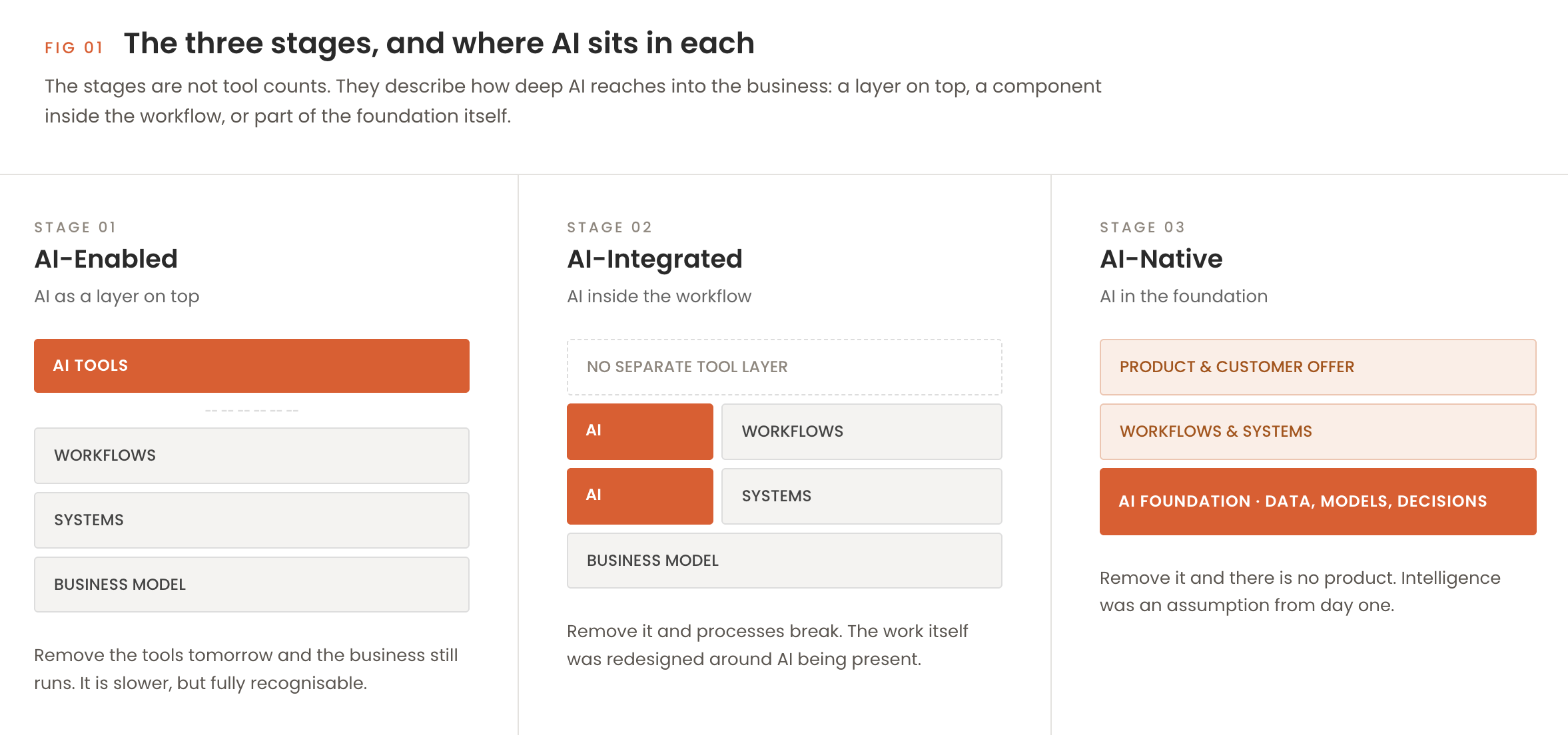
An AI-enabled business uses AI to improve specific tasks without fundamentally changing the structure of the business itself. At this stage, AI is genuinely helpful, but it is not essential to how the company was originally built or how it continues to run. The tools sit on top of the existing model and make certain parts of the work faster or more efficient. That is a real benefit, and it is a perfectly reasonable place to begin.
This is where most organisations start. A marketing team might use AI to draft social media captions or brainstorm campaign ideas. A customer service team might use it to summarise conversations or suggest replies for common questions. A sales team might rely on AI to research prospects or prepare follow-up emails. In each case, the company is still operating in essentially the same way it always has. AI simply helps people move through their existing responsibilities with a bit less friction.
The clearest way to tell whether a company is still in this stage is to ask what would happen if those tools disappeared tomorrow. In most cases, the business would keep going. The work might take longer, but the operating model would remain fully recognisable. That continuity is what makes this stage a starting point rather than a destination.
For many businesses, AI-enabled is the right place to begin. It gives teams room to experiment, build confidence, and identify where AI creates real value. There is nothing wrong with being here, especially early on. That said, if AI stays only as an add-on, the business will improve incrementally without changing in a meaningful way. That is worth keeping in mind as you grow.
AI-integrated businesses have moved past the helpful add-on phase. At this stage, AI becomes embedded into the workflows, systems, and decision-making processes that keep the business running daily. The shift sounds subtle, but in practice it changes quite a lot about how the organisation functions.The most visible difference is that AI is now shaping how work moves through the entire organisation, not just how individual tasks get completed. A customer support platform may automatically classify and prioritise incoming tickets before any human looks at them. A finance team may use AI to flag anomalies in transaction data that would take an analyst hours to find manually. An operations team may use forecasting models to predict demand shifts and adjust inventory before problems become hard to fix.
What makes this meaningfully different is the intent behind the design. AI-integrated businesses are no longer simply asking what AI can do for them. They are asking how their processes should change now that AI is part of how they work. That shift moves AI from the edges of the business into the actual machinery of daily operations.
This stage tends to produce the most visible short-term results. Integration can improve speed, reduce repetitive manual work, and help teams stay more coordinated. It can also improve decision quality by giving people better data and more timely insights. Patterns that used to take weeks to surface in a quarterly review can show up in real time, while there is still a chance to act on them.
Human judgment remains central at this stage, but it is now consistently supported by systems that can analyse information faster and operate at a scale no individual could match alone.
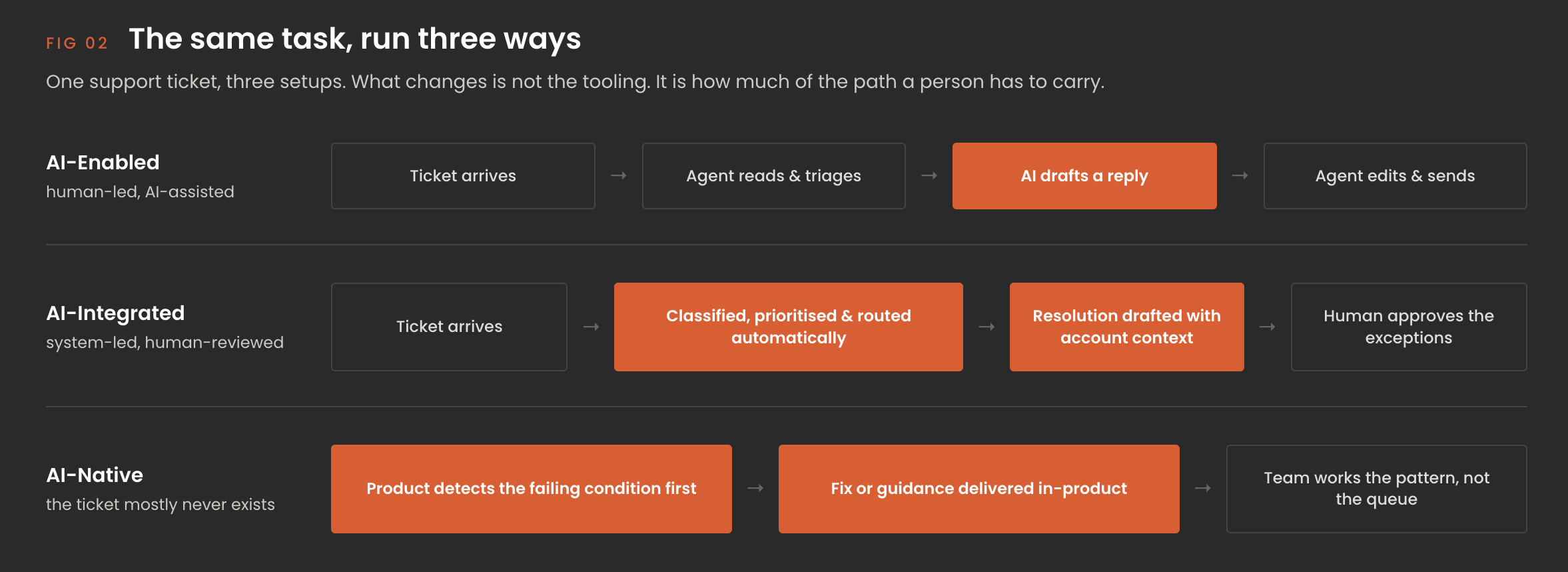
These three stages reflect something more important than technical maturity. They reveal how a company thinks about transformation and what it wants to become.
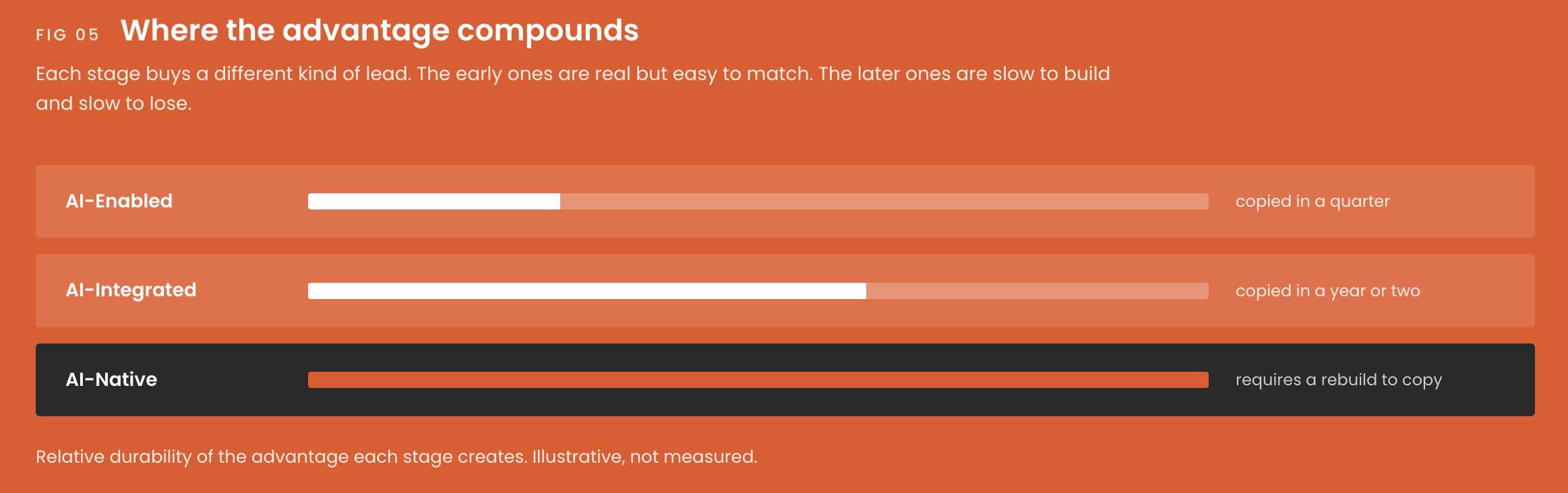
AI-enabled businesses use AI to improve individual tasks. AI-integrated businesses use AI to improve entire workflows and decision-making processes. AI-native businesses use AI to shape the architecture of the whole organisation.
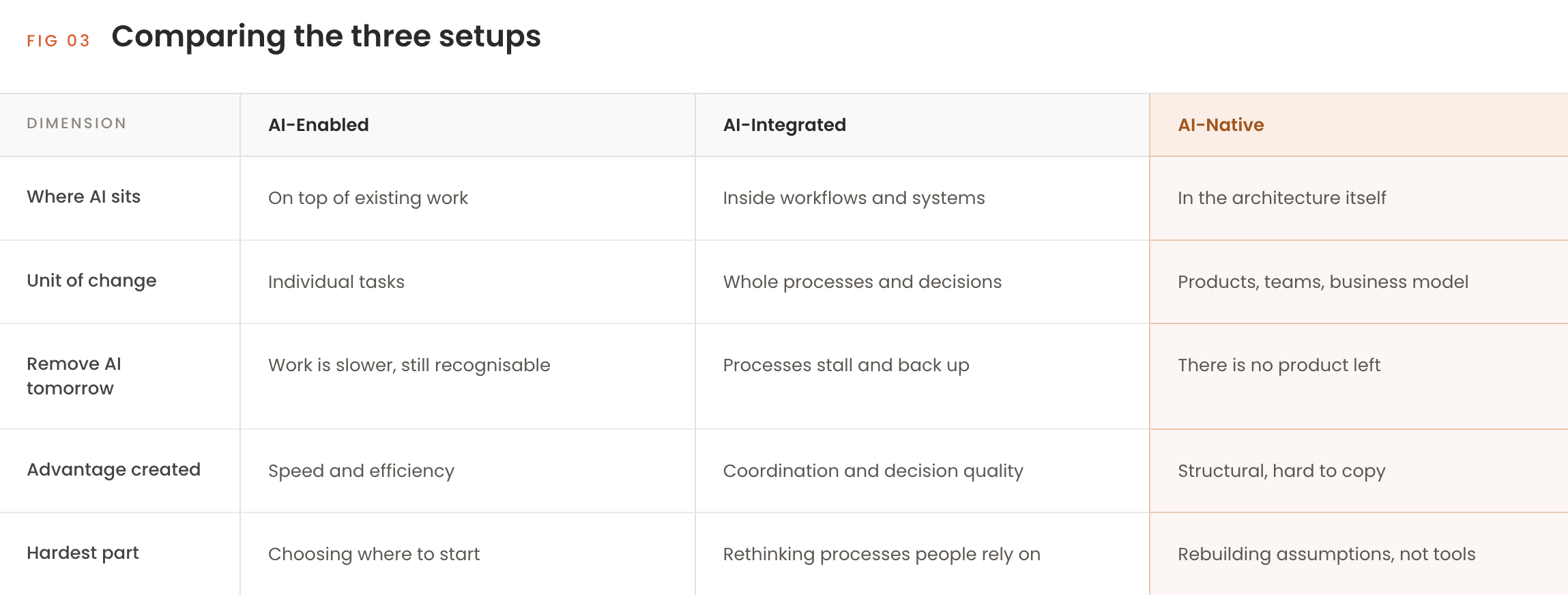
Each stage creates a different level of advantage. AI-enabled companies gain speed and efficiency, which is genuinely valuable. AI-integrated companies gain coordination and better decision quality, which compounds over time in ways that become very obvious later. AI-native companies gain a structural advantage embedded in how value is created and delivered, and it is much harder for competitors to replicate by simply adopting better tools.
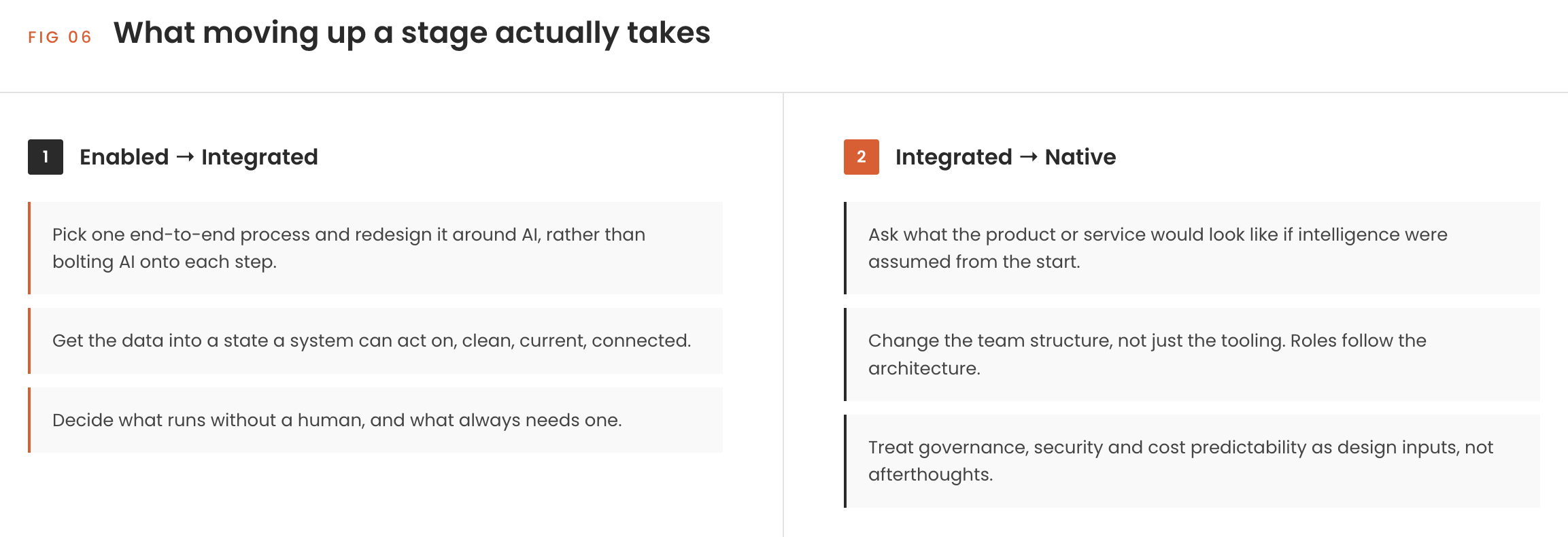
This is also why so many companies stop too early and then wonder why their results plateau. They adopt a handful of tools, see a productivity boost, and quietly conclude they have figured out AI. But the real opportunity usually starts after those early wins. The next question is whether AI should change the workflow, the team structure, the product, or even the business model itself. Those are harder questions, but they are also the more worthwhile ones.
Instead of asking whether your business is using AI, a more useful question is what role AI actually plays in how your business creates value.
Is AI just helping people work a bit faster on tasks they were already doing? Is it genuinely embedded into the systems that run the company every day? Or is it part of the business’s foundational design, shaping how products are built and how customers are served?
Answering honestly requires looking past the tools themselves and examining the actual impact on how the organisation functions. Many businesses describe themselves as AI-forward while still operating comfortably in the AI-enabled stage. That is not a failure. But mistaking where you are for somewhere further along can lead to strategies that do not quite fit where the business actually is.
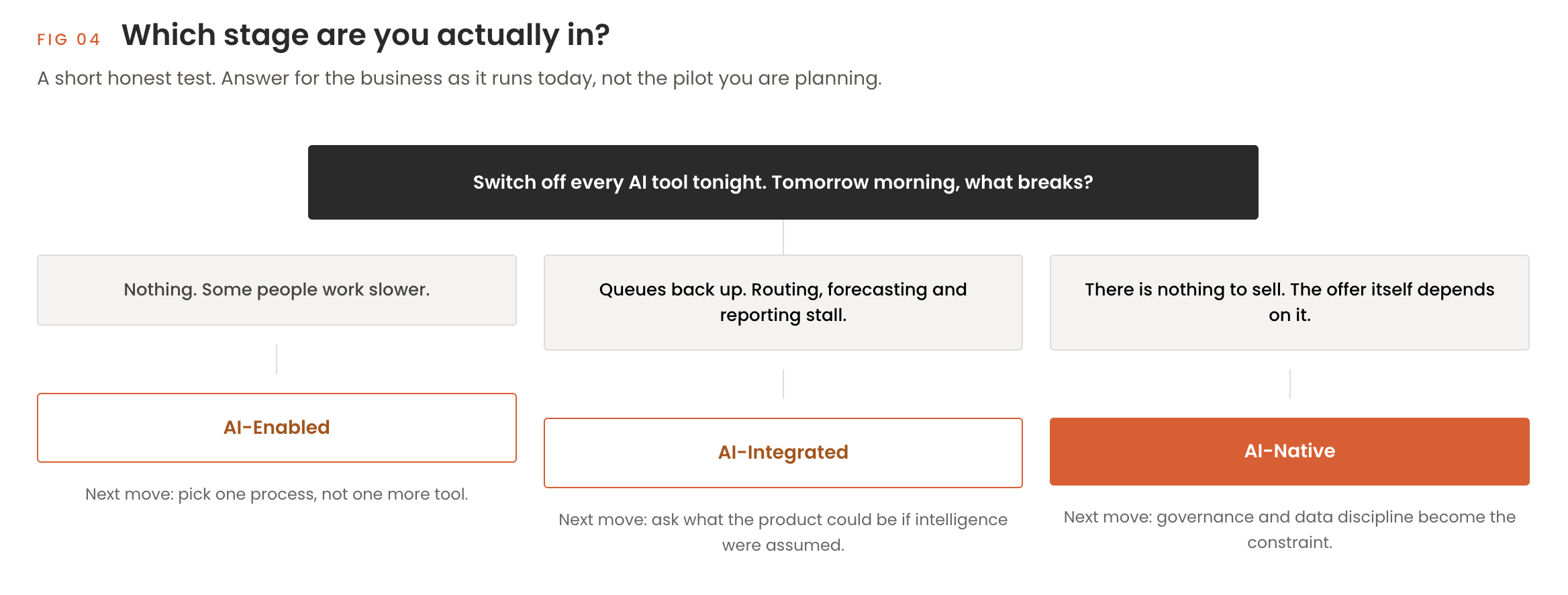
Once you have a clear and honest answer, everything else becomes easier to work through. Investment decisions get sharper. Priorities become clearer. The gap between where the business is and where it wants to be stops feeling vague and starts feeling like something you can actually close.
The businesses that get this right will not simply use AI more often. They will use it more deliberately and in ways that genuinely change how the business works at its core. That difference, between using AI frequently and using it meaningfully, is ultimately what separates companies that improve a little from companies that build something genuinely hard to compete with.
Right now, while the landscape is still shifting and most competitors haven’t yet moved past the first stage, it’s a pretty good time to start asking what kind of company you want to be.
AI-enabled organisations use AI tools to improve individual tasks and workflows. AI-integrated organisations embed AI into business processes and operational systems. AI-native organisations design processes, decision-making and customer experiences around AI from the outset. These three stages represent a common AI maturity model that many businesses progress through during their AI transformation journey.
An AI-enabled business uses AI tools to assist employees with productivity, research, content creation, reporting and basic automation. AI typically supports existing processes rather than fundamentally changing how the organisation operates.
An AI-integrated organisation embeds AI into operational workflows, business systems and decision-making processes. AI becomes part of how work gets done rather than an optional productivity tool used by individual employees.
An AI-native company is designed around AI from the beginning. Business processes, customer interactions, decision-making and operational models are built with AI at their core. AI-native organisations often achieve greater scalability and efficiency because AI is embedded across the business.
Organisations typically progress by identifying repetitive workflows, integrating AI into systems, automating routine processes and establishing governance frameworks. Successful AI adoption requires both technology implementation and organisational change management.
Many organisations focus on experimenting with AI tools without connecting them to business objectives. Effective AI transformation requires clear use cases, measurable outcomes, strong governance, employee adoption and integration with existing systems and workflows.
Not necessarily. The appropriate level of AI adoption depends on industry requirements, operational complexity, risk tolerance and strategic objectives. Many organisations can generate significant value as AI-integrated businesses without fully transitioning to an AI-native operating model.
AI adoption is accelerating across professional services, financial services, manufacturing, healthcare, logistics, retail and technology sectors. Organisations are increasingly using AI to improve efficiency, automate workflows and strengthen decision-making.
Small and mid-sized businesses should start with targeted use cases that solve specific operational challenges. Common starting points include AI-assisted reporting, workflow automation, customer service improvements and employee productivity tools. A structured AI strategy helps ensure investments deliver measurable outcomes.
AI governance helps organisations manage security, compliance, privacy, data quality and responsible AI use. As businesses become more AI-integrated, governance becomes increasingly important for controlling risk and maintaining trust.
AI transformation is often an extension of digital transformation. While digital transformation modernises processes and technology platforms, AI transformation introduces intelligence, automation and decision support capabilities that further improve efficiency and business performance.